The Places That Never Let You Go: On Landscapes That Live Inside You
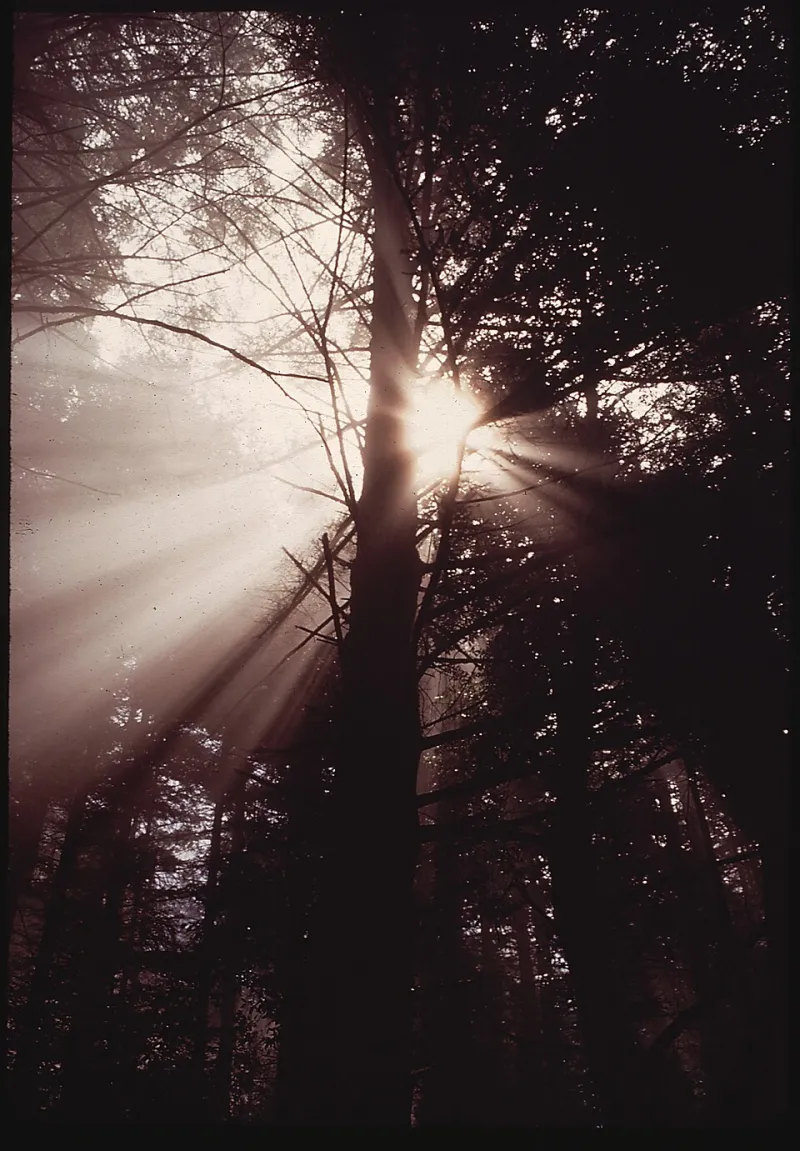
Photo: Tomas Sennett, Public domain, via Wikimedia Commons
There's a particular quality of light that still stops me cold. It happens in late afternoon, usually in October, when the sun drops low and throws itself sideways through a stand of trees. Doesn't matter where I am — a park in Chicago, a rest stop in Tennessee, my own backyard. When the light does that thing, I'm briefly somewhere else entirely. I'm eleven years old, standing at the edge of a pine forest in the Appalachian foothills, and for just a moment, the intervening years collapse like a paper fan.
Most of us have something like this. A smell of river mud that ambushes you at a farmer's market. The particular way wind sounds moving through a canyon that you hear, impossibly, in a city alley. A quality of silence that belongs to a specific mountain valley but keeps showing up uninvited in your chest.
These aren't just memories. They're something more stubborn than that.
How a Place Gets Inside You
Neuroscientists have spent considerable time studying what they call "place memory" — the way our brains encode location not just as visual data but as a full-body sensory experience. The hippocampus, which handles spatial navigation and memory formation, is also deeply tied to emotional processing. In other words, the brain doesn't file a landscape away the way you'd file a document. It stores it alongside the fear, the joy, the particular ache of being young in a place that felt enormous and full of meaning.
Children, especially, are absorbing landscape at a rate adults rarely match. When you're small, the world is proportionally huge. A creek is a river. A neighborhood woodlot is a forest. The scale of your environment relative to your body imprints differently than it will when you're grown and the world has shrunk to a manageable size. Those early landscapes don't just become memories — they become templates. The brain uses them as reference points, a kind of emotional baseline against which everything else is quietly measured.
This is partly why homesickness for a natural environment can feel so different from missing people. Missing a person is about relationship, reciprocity, shared history. Missing a landscape is more like missing a version of yourself — the self that existed in that particular light, under that particular sky, with that particular smell of pine resin or salt marsh or red clay dust in the air.
The Sensory Anchors We Don't Choose
What's striking is how arbitrary the trigger points can be. It's rarely the dramatic stuff. Not the famous overlook or the postcard-perfect vista. It's the mineral smell of a specific river after rain. The way certain grasses hiss when wind moves through them. The exact texture of a particular kind of soil under your feet.
These sensory details become what psychologists sometimes call "emotional anchors" — involuntary cues that reconnect us to a stored emotional state. They bypass rational thought almost entirely. You don't decide to feel homesick for the Ozarks or the high desert of New Mexico or the flat, enormous sky over the Texas panhandle. The smell of cedar or sage or wet limestone just reaches into you and pulls.
For people who grew up in regions with strongly distinctive natural environments — the Pacific Northwest with its particular green dampness, the Gulf Coast with its heavy salt air and subtropical heat, the Great Plains with their vertiginous openness — this effect can be especially pronounced. The landscape was so specific, so sensory-dominant, that it left marks that don't fade with distance or time.
Why Some People Can't Quite Leave
There's a reason certain people spend their adult lives quietly restless in places that are perfectly fine but aren't quite right. They're not being precious about it. They're responding to something genuine — a mismatch between the landscape that shaped them and the landscape they currently inhabit.
Environmental psychologists use the term "solastalgia" to describe the grief people feel when a beloved landscape changes or disappears. But there's a quieter, less-named version of this — the low-grade longing of someone who simply lives far from the terrain their nervous system recognizes as home. It doesn't incapacitate you. It just sits there, surfacing whenever the light hits a certain way or the wind carries something familiar.
This is why some people move back to their home regions after years away and feel, immediately, a kind of physical relief they hadn't realized they'd been waiting for. The body recognizes something the mind had half-forgotten. The shoulders drop. The breathing changes. Something that had been faintly braced relaxes.
And it's also why others — people who've built full, meaningful lives far from where they started — still feel that particular pull. Not regret, exactly. More like a compass needle that keeps pointing in one direction even when you're not going that way.
Living With the Haunting
I've talked to enough people about this to know it's nearly universal, even if we don't have great language for it. The woman who grew up on the Oregon coast and still, twenty years into life in Atlanta, feels something loosen in her chest when she smells the ocean. The man who was raised in the canyon country of southern Utah and finds himself standing in front of landscape paintings in museums, looking for a specific quality of red rock light. The Midwesterner who didn't know how much they loved the flatness until they moved to the mountains and couldn't stop feeling vaguely crowded.
None of this is pathology. It's just what it means to have been formed by a place — to have let a landscape into you during the years when you were still becoming who you are. Those environments didn't just provide backdrop. They participated in your formation. The wind through the canyon, the slant of afternoon light through the trees, the cold particular smell of a river in November — these things were present during the moments that made you. Of course they stayed.
Maybe the more honest thing to say is that we don't leave our formative landscapes so much as we carry them. They become interior weather — something that moves through us on its own schedule, rising and receding, never entirely gone.
And maybe that's not a problem to solve. Maybe it's just the cost of having been somewhere real, with someone you still are, in a place that meant something before you knew enough to say so.