Somewhere I've Never Stood: On Falling in Love With Places That Only Exist in Words
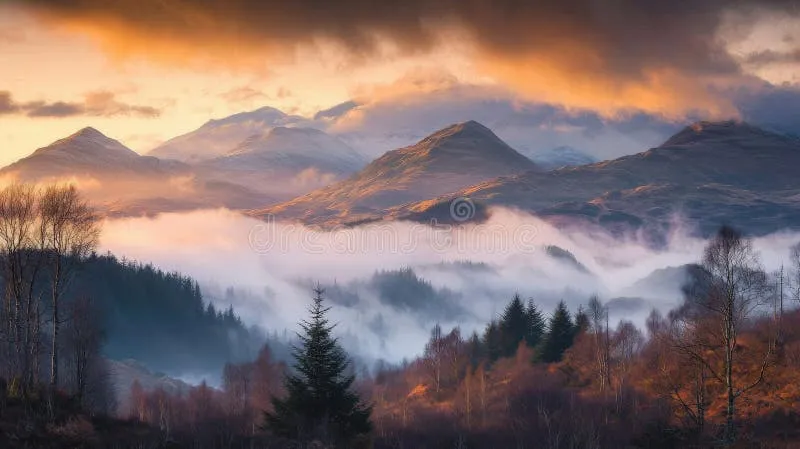
Photo: misty highland landscape fog rolling over hills dramatic sky, via thumbs.dreamstime.com
I have never been to the Scottish Highlands. I have never watched morning fog roll off a Highland loch or felt the particular bite of Atlantic wind funneling through a glen. But I have written about it. Twice. Once in a journal entry that went nowhere, and once in a personal essay that somehow felt more honest than most things I've written about places I've actually visited.
That's the strange alchemy at the heart of this: sometimes the places we've never touched feel more real to us than the ones we've stood in.
The Map We Draw in Our Heads
Long before Google Earth made armchair travel a pixel-perfect experience, readers were building elaborate interior landscapes from the raw material of other people's words. Think about how many Americans grew up with a vivid sense of the English moors — not from travel, but from Brontë. Or the Alaskan wilderness, conjured not from personal experience but from Jack London's prose, so cold and muscular you could practically feel the frostbite.
We are, it turns out, remarkably good at assembling imaginary places. The brain doesn't distinguish as cleanly as we'd like between sensory memory and vividly imagined experience. Read enough about the way sagebrush smells after a desert rainstorm in New Mexico, and some part of your nervous system files it away like a postcard from somewhere you've been.
Writers exploit this. Readers depend on it. And somewhere in that exchange, a strange kind of longing is born.
Why We Write What We Haven't Seen
There's a persistent myth that writing authentically about place requires physical presence — that you have to earn the right to describe a landscape by standing in it. And there's truth there, certainly. The specificity that comes from real experience is hard to fake. You can't fully conjure the way light moves through a coastal redwood forest without having squinted up into it yourself.
But that's not the whole story.
Some of the most powerful nature writing comes not from the place itself but from the idea of it — from the gap between where we are and where we imagine ourselves. That gap is generative. It's where longing lives, and longing, as any writer will tell you, is one of the most honest emotions we have access to.
When I write about the Highlands without having been there, I'm not pretending to expertise I don't have. I'm doing something different: I'm writing about the version of that place that exists inside me, assembled from photographs and poetry and the particular quality of light in a documentary I watched at 11 p.m. on a Tuesday. That interior landscape is real, even if the geography isn't perfectly accurate. It tells the truth about my yearning, even if it fudges the elevation.
The Digital Nature Problem
In the age of Instagram and nature content — the gorgeous drone footage of Patagonia, the perfectly timed wildlife videos, the aesthetic cabin-in-the-woods accounts with 800,000 followers — we consume more images of distant landscapes than any generation before us. And yet, paradoxically, many of us feel further from nature than ever.
There's a version of armchair travel that nourishes, and a version that just makes you feel worse. Reading about a place — really reading, slowly, with attention — tends to do the former. It builds something. It gives you language for a longing you didn't know how to name. Scrolling through curated wilderness photography, on the other hand, can sometimes deepen the distance. You're not building a relationship with a place; you're consuming it.
The difference, I think, is participation. Writing requires you to do something. Even reading, done well, is an active act. You're not just receiving an image — you're translating words into sensation, filling in gaps, making choices about what the light looks like, what the air tastes like. You're co-creating the place.
That's why literature has always been the more powerful transport. Not because it's more accurate, but because it makes you do the work of imagining.
What the Longing Is Actually About
Here's the thing I keep coming back to: when we write about places we've never been, we're rarely just writing about those places.
The Highlands I write about are partly about solitude I'm craving. The Sonoran Desert essay a friend of mine wrote — she grew up in Ohio, has never been further west than Chicago — was really about silence, and the particular kind of space she needed in her life at thirty-four. The place was the vessel. The longing was the cargo.
This is not a criticism. It's actually, I think, one of the most important functions that nature writing serves: it gives us a vocabulary for internal states that are otherwise hard to articulate. We reach for landscapes because landscapes can hold what we feel. The wide open prairie can hold a loneliness that's too big for a living room. The deep ocean can hold a grief that doesn't fit in ordinary language.
When a reader in suburban Ohio picks up a book about the bayous of Louisiana and feels something loosen in their chest — that's not escapism, exactly. That's recognition. The place they've never visited is showing them something about themselves they couldn't quite see before.
Permission to Write the Places You Haven't Been
So here's what I want to say to every writer who's hesitated to put words to a landscape they've only dreamed about: write it anyway.
Write about the coast you've never touched, the forest you've only seen in photographs, the canyon you've been meaning to visit for fifteen years. Write it with humility — acknowledge the gaps, let the imagination be visible — but write it. Because the act of reaching toward a place in words is its own form of being there. It's its own kind of arrival.
The places we long for are never entirely separate from the places we are. They're the other half of the same conversation. And if Wind & Words has taught me anything, it's that the wind you've never felt can still move you — if you find the right words for it.
Some of the truest things we'll ever write are about places we may never actually stand in. That's not a limitation. It's an invitation.