Holding Still: What the Sky Knows About the Art of Waiting
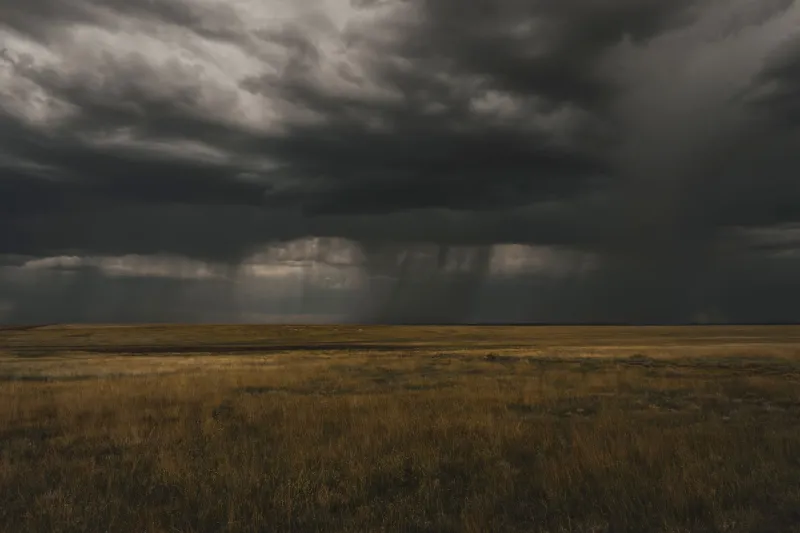
I grew up in central Ohio, where the weather has always had opinions. Summers there don't just change — they announce themselves. One afternoon last June, I was sitting on my back porch watching a line of thunderstorms crawl across the horizon when I noticed something strange: everything had gone completely quiet. The birds stopped. The wind dropped to nothing. Even the leaves seemed to hold their breath.
Meteorologists call it the calm before the storm. I've since learned there's actual science behind it — a temporary pressure shift, a kind of atmospheric inhale before the exhale. But in that moment, all I could think was how familiar it felt. Not as weather, but as life.
The Meteorology of In-Between
I'd been in one of those personal pressure drops myself. Three months earlier, I had left a decade-long career in marketing to try something I'd always wanted to do: write. The resignation letter was easy. What came after was not. I was living in the strange, suspended territory between who I had been and whoever I was becoming — and I had absolutely no forecast for it.
I started talking to people who spend their lives reading the sky, hoping they might have something to say about the ground beneath my feet.
Dr. Alicia Moreno, an atmospheric scientist based in Norman, Oklahoma, has spent fifteen years studying the behavior of supercell thunderstorms. When I asked her about the quiet before severe weather, she didn't just describe it technically — she described it almost reverently.
"There's real energy in that stillness," she told me over the phone, her voice steady and unhurried. "What looks like nothing happening is actually everything happening. The atmosphere is reorganizing itself. It's building toward something it doesn't quite have language for yet."
I wrote that down twice.
Storm Chasers and the Courage to Stay in Uncertainty
Marcus Tillman has been chasing storms across Tornado Alley for over a decade. Based out of Amarillo, Texas, he's a self-described "professional waiter" — someone who drives hundreds of miles just to sit in a parking lot watching clouds that may or may not do anything at all.
"Most people think storm chasing is all adrenaline," Marcus told me, laughing a little. "But honestly? Ninety percent of it is patience. You read the data, you position yourself, and then you wait. And sometimes the storm just... doesn't develop. It falls apart. You drove six hours for a drizzle."
I asked him how he handles that — the anticlimax, the uncertainty, the not-knowing.
"You stop fighting it," he said simply. "You learn that the waiting is the work. The storm will do what it does. Your job is just to be present enough to see it when it comes."
That landed somewhere deep. Because the hardest part of my own transition wasn't the change itself — it was the weeks and months of ambiguity that followed. The mornings I woke up without a title or a team or a clear sense of what I was building. The silence felt less like peace and more like failure wearing a disguise.
After the Storm Passes
There's another kind of quiet that doesn't get talked about as much: the one that comes after severe weather. If the pre-storm calm is charged with anticipation, the post-storm stillness is something else entirely — washed clean, a little raw, rearranged.
Dr. Moreno described it as a kind of atmospheric reset. "The storm has done its work," she said. "The atmosphere reaches a new equilibrium. It's not the same as before. It's genuinely different."
I thought about the endings I'd moved through — a long relationship that dissolved quietly over several years, a friendship that simply drifted, the career I finally let go. Each one had its own aftermath. That peculiar stillness where you're no longer who you were, but not yet sure who you are. Where the landscape of your life looks familiar but somehow altered, like your own neighborhood after a hard rain.
Marcus put it well, in the plain-spoken way of someone who has watched a lot of skies. "After a tornado, the light changes. It gets this golden quality. Everything looks more itself somehow. I don't know how to explain it scientifically. I just know I've seen it every time."
Learning to Read Your Own Weather
What I've come to understand — slowly, imperfectly — is that the pauses in our lives aren't empty. They're doing exactly what that pre-storm atmosphere does: reorganizing, building pressure, preparing for something that doesn't have a name yet.
We live in a culture that's deeply uncomfortable with stillness. We refresh our feeds, fill our calendars, narrate our transitions on social media before we've even finished living them. We treat uncertainty like a problem to be solved rather than a season to be moved through.
But the weather doesn't apologize for its pauses. A storm system doesn't rush its development because we're impatient for resolution. The sky takes exactly as long as it takes.
Sitting on that porch in Ohio, watching the clouds build and the light go strange, I felt something shift in me. Not a dramatic revelation — more like a quiet permission. Permission to be in the middle of something without already knowing the end. Permission to hold still while the atmosphere around me did its reorganizing work.
The storm came eventually, loud and brief and magnificent. And then it was gone, leaving the air smelling like earth and electricity and something I can only describe as newness.
I went inside and wrote for three hours straight. It wasn't great writing. But it was mine.
The Wind Knows
I'm still in the transition, if I'm honest. The career shift is real but unfinished. Some mornings the silence still feels less like peace and more like doubt wearing a patient face. But I've started to notice the quality of the light differently. I've started to trust that the stillness has its own intelligence — that it's not the absence of movement, but the presence of something gathering itself.
Marcus told me one last thing before we hung up, almost as an afterthought.
"I've chased hundreds of storms," he said. "The ones I remember most aren't always the biggest. Sometimes it's just the way the sky looked in the waiting. There's beauty in that part too, if you let yourself see it."
I think that's the whole lesson, honestly. The storms will come and go. What we practice in the silence between them — that's where we actually learn to live.